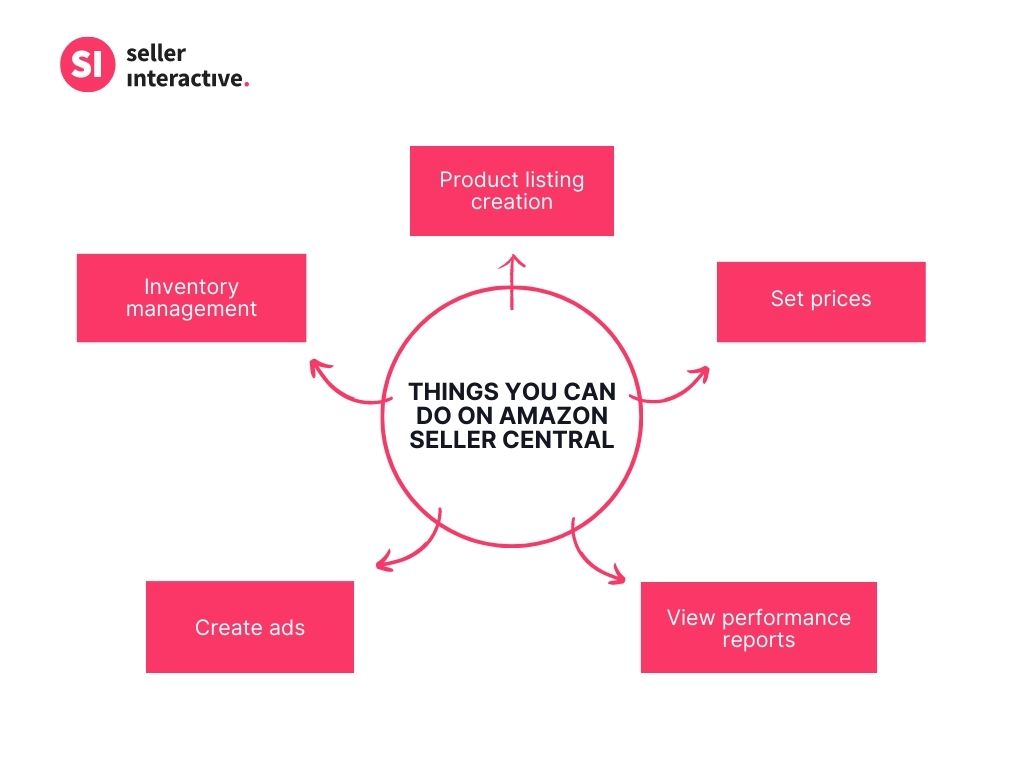
Amazon seller account management refers to the ongoing process of overseeing and coordinating all the core functions required to run a business on Seller Central, including listings, advertising, inventory, account health, and performance reporting. It’s not a single task but a connected system of operational responsibilities.
As brands scale, this system becomes more difficult to manage. What starts as a simple setup with a few products quickly grows into a complex operation involving multiple SKUs, higher ad spend, tighter inventory planning, and stricter performance requirements. Each new layer adds dependencies that must be managed carefully.
This is why operational coordination becomes essential. Seller Central functions are closely linked, meaning changes in one area often affect others. Without coordination, performance can become inconsistent and harder to control.
Many sellers struggle not because of product quality, but because operations become fragmented across people or processes. Strong account management directly influences profitability, advertising efficiency, inventory stability, account health, and long-term growth sustainability.

New sellers assume account management mainly involves creating product listings. However, Seller Central operates as an interconnected system where decisions in one area can directly influence performance in others. Effective management therefore requires oversight of multiple operational functions, including product listings, PPC advertising performance, inventory planning and forecasting, and account health monitoring.
Beyond these core areas, sellers must remain compliant with Amazon policies, regularly review reporting and analytics, manage customer experience issues, maintain accurate catalog data, coordinate promotional activity, and ensure that any internal teams or external service providers are aligned. As businesses grow, these responsibilities become more interconnected, making coordination and consistency just as important as individual execution.
A stockout, for instance, affects more than just inventory levels; it can also reduce organic rankings, disrupt advertising efficiency, lower revenue, and complicate future forecasting. Similarly, poor listing quality can reduce conversion rates, which often increases advertising costs due to lower efficiency. This interconnected structure is why account management is an ongoing operational process rather than a one-time setup, requiring continuous monitoring, optimization, and adaptation to marketplace changes.
Most sellers experience a point where growth begins creating complexity. A seller managing five products may be able to manually monitor inventory and campaigns. At fifty products, small issues become harder to spot, and operational processes often need to evolve before growth starts creating bottlenecks.
One of the first changes sellers notice is simply the increase in SKUs. Each new product adds its own listing requirements, keyword strategy, advertising structure, and inventory needs. Instead of managing a handful of pages, sellers may find themselves responsible for dozens or even hundreds of ASINs, each requiring ongoing attention to stay competitive and accurate.Â
As catalogs grow, PPC management becomes more layered and time-consuming. Campaign structures grow, keyword targeting expands, and budget decisions become more strategic. It becomes harder to quickly understand what is driving performance, especially when multiple campaigns are running across different product lines with different goals.Â
Inventory forecasting becomes more challenging as sales volume increases. Predicting demand is no longer based on simple trends but must account for seasonality, promotions, supplier lead times, and shifts in conversion rates. A small forecasting error at scale can lead to either costly overstock situations or stockouts that affect rankings and momentum.Â
Policy changes and compliance requirements add another layer of complexity. Amazon frequently updates guidelines, and as catalogs grow, there are more opportunities for listings to become affected by new rules. This can lead to suppressed listings or sudden performance warnings that require quick attention to avoid disruption.Â
Some sellers also begin to experience issues like rising TACoS, which can signal that advertising efficiency is becoming harder to maintain as competition increases or as listings become less optimized.Â
Fragmented support structures, such as multiple freelancers or agencies working in isolation, can make it difficult to maintain a clear, unified strategy across the account. One team member may be handling ads, another may be updating listings, and another may be managing inventory, but without alignment, small gaps can form between these functions. Over time, these gaps can slow down decision-making and reduce overall efficiency.Â
Ultimately, scaling issues are not usually caused by a single problem. They tend to emerge from the increasing complexity of managing interconnected systems inside Seller Central. As the business grows, the need for structure, consistency, and coordination becomes more important than ever.Â
These challenges are common and don’t necessarily indicate poor management. They simply reflect the reality that scaling an Amazon business requires increasingly sophisticated operational systems.

While various operational areas can be handled separately, they work best when treated as part of a unified system. Performance in one area can directly affect outcomes in another, which is why strong seller account management depends on consistent oversight across all core functions.

A product can receive thousands of impressions each month yet still struggle to generate sales if images fail to communicate value or important information is buried in the description.
Key elements include title optimization, where product titles are structured to improve both search visibility and shopper clarity; image quality, since high-quality visuals help communicate value and increase click-through rates; and ongoing listing updates to reflect product improvements, pricing changes, and evolving marketplace requirements.
Variation structures must be carefully managed to ensure related products are grouped correctly, which helps improve customer experience and conversion rates. A common example is when product variations are separated incorrectly, forcing customers to navigate multiple listings instead of comparing options within a single product family. Small catalog issues like these can quietly reduce conversion rates over time.
Preventing listing suppression is another critical responsibility, as missing attributes or compliance issues can quickly reduce visibility or pause sales altogether. Sellers often discover these problems only after sales decline, highlighting the importance of routine catalog monitoring rather than reactive fixes.
Beyond structure and compliance, listing performance relies heavily on SEO optimization and conversion optimization. This means aligning keywords with customer search behavior while also ensuring that once customers arrive on the page, the content effectively supports purchase decisions.Â
This dynamic becomes especially clear when analyzing listing performance at scale. High-ranking listings don’t always generate the most sales. Some products perform well in search results but struggle to convert because the content fails to answer common customer questions or differentiate the product from competing alternatives. Balancing discoverability with conversion effectiveness is an important tradeoff in listing management.
Advertising is one of the most active and data-driven components of managing Amazon seller accounts. Effective PPC oversight requires strategic planning, ongoing optimization, and careful monitoring of performance data. Well-structured campaigns help organize advertising efforts for clearer reporting and more efficient scaling, while spend control ensures budgets are allocated effectively across products and campaigns.Â
A common mistake sellers make is focusing only on ACoS and ad spend without considering broader business performance. TACoS is an important metric because it measures how advertising impacts overall profitability, not just campaign-level results. Keyword targeting helps ads reach relevant shoppers, while scaling campaigns requires balancing growth with efficiency.Â
The tradeoff is that increasing budgets can drive additional sales but may reduce profitability if conversion rates or margins are not strong enough to support the added spend. This becomes visible when a seller increases ad budgets to boost growth while an underperforming listing limits conversions. Traffic rises, but results remain disappointing.Â
This highlights an important observation: advertising rarely succeeds in isolation. PPC performance is influenced by listing quality, inventory availability, pricing, and overall account management. Strong PPC management is not just about launching campaigns but continuously refining them based on performance data and business goals.
Inventory management is one of the most operationally sensitive areas of an Amazon business, and one of the most common sources of avoidable mistakes. Poor forecasting decisions come from relying on short-term sales trends without accounting for longer planning cycles, which can quickly lead to either lost sales or unnecessary storage costs.
Stockouts are particularly damaging because they interrupt sales momentum, reduce rankings, and impact advertising efficiency. In many cases, sellers only recognize the issue after performance has already declined, even though the underlying problem developed weeks earlier through slow replenishment planning. On the other hand, overstocking creates financial pressure through increased FBA storage fees and ties up capital that could be used for advertising, new product launches, or expanding best-performing SKUs. This creates a constant balance between maintaining availability and protecting cash flow.
Forecasting becomes more challenging as businesses grow, especially when factoring in seasonal demand fluctuations, promotional periods, and shifts in customer behavior. A product may perform steadily for most of the year but then experience sudden spikes during peak seasons, which can lead to rushed emergency restocks or excess inventory carried into slower months. These situations demonstrate that inventory planning is rarely static and must continuously adapt to changing demand patterns.
Account health and compliance are critical for maintaining uninterrupted access to the Amazon marketplace, yet many sellers treat this as a reactive function instead of an ongoing operational priority. Issues are often only addressed after warnings appear, even though the underlying problems usually build up gradually through everyday listing, catalog, and fulfillment decisions.
Policy violations can occur when listings don’t fully meet Amazon’s requirements, while IP complaints may arise from intellectual property concerns tied to product content or branding. Suppressed ASINs are also common, limiting visibility and sales when listings fail to meet compliance standards or required data fields. These issues are often the result of small, repeated gaps in maintenance rather than isolated mistakes.
Performance metrics such as late shipment rates are closely monitored and can quickly impact account standing if not consistently controlled. Sellers sometimes underestimate how quickly minor fulfillment delays can affect overall performance, especially during peak periods. Performance notifications act as early warnings, but delays in addressing them can allow issues to escalate.
Maintaining compliance requires continuous attention even when no immediate problems are visible. When neglected, these factors can increase suspension risk and disrupt business operations, making account health one of the most sensitive areas of Seller Central.
Analytics and reporting provide the visibility needed to make informed operational decisions. Without structured reporting, it becomes difficult to understand what is driving performance or limiting growth.
Profitability tracking helps sellers understand true margins after accounting for advertising, fees, and operational costs. Ad performance analysis evaluates how efficiently marketing spend is converting into sales.
Conversion rates provide insight into listing effectiveness, while operational KPIs help measure broader business performance across multiple functions. Identifying inefficiencies within these metrics allows sellers to make targeted improvements rather than relying on assumptions.
Strong reporting systems connect all areas of the business, making it easier to see how advertising, inventory, listings, and operations work together to influence overall performance.
There is no single “correct” way to structure Amazon operations. Successful brands organize their workflows based on their stage of growth, available resources, and internal capabilities. What works for a small catalog managed by a founder is often very different from what a scaling brand with multiple product lines requires.
In the early stages, many Amazon businesses are managed directly by the founder. This structure is common when the catalog is small and the business is still in its validation phase. The main advantage is full visibility and control. Decisions can be made quickly, and there is no dependency on external coordination or communication layers.
However, limitations appear as the business grows. Time becomes the primary constraint. Managing PPC, inventory planning, listing optimization, and reporting all at once can become difficult to sustain. As a result, strategic work gets pushed aside in favor of day-to-day operational tasks. Scaling under this model can become challenging without introducing additional support.
As operations expand, some sellers build in-house teams to manage different parts of Seller Central. The main advantage of in-house teams is control and alignment. Communication is faster, and internal teams develop a deeper understanding of the brand. This structure is particularly effective for larger catalogs or brands with consistent, predictable workflows.
The limitation is overhead. Hiring, training, and managing employees requires significant investment. In addition, specialized skills such as advanced PPC optimization or complex forecasting requires experienced hires, which increases costs. Coordination between roles also becomes important to avoid siloed decision-making.
Many sellers rely on freelancers or independent specialists to handle specific functions. This offers flexibility and access to specialized expertise without the commitment of full-time hires and can be especially useful for brands that need targeted support.
However, coordination can become a challenge. Freelancers work independently, which can lead to fragmented execution if there is no centralized strategy. For example, PPC changes may not align with inventory planning, or listing updates may not reflect advertising priorities. Without strong oversight, this can create inconsistencies across the account.
A hybrid model combines internal oversight with external support. In this structure, a founder or internal operator retains strategic control while leveraging freelancers or specialists for execution.
This model is common among growing brands because it balances flexibility with structure. Internal leadership ensures alignment across the business, while external specialists provide execution capacity in areas like advertising, creative production, or catalog updates.
The main challenge is coordination. Even with a hybrid setup, strong communication systems are required to ensure all contributors are working toward the same objectives. Without clear processes, responsibilities can overlap or become unclear.
Some businesses choose to work with external teams or an Amazon management agency to oversee broader operational coordination. These providers support multiple areas of Seller Central, including advertising, listings, reporting, and inventory planning.
One advantage of this model is centralization. Instead of managing multiple freelancers or separate workflows, sellers work through a single point of coordination. This can reduce fragmentation and improve consistency across operations. Agencies or account managers may also bring cross-functional experience from working with multiple brands.
However, this structure is not without limitations. Quality can vary significantly between providers, and the level of involvement may differ depending on the engagement model. Some sellers also prefer maintaining direct control over certain areas of their business, especially strategic decisions or financial planning.
Scalability is another consideration. While agencies can support growth, the effectiveness of the relationship depends on communication quality and how well the provider integrates with the brand’s internal systems.

One common mistake is treating advertising as the main growth lever while overlooking everything else. A seller may continuously increase PPC spend to drive traffic but ignore that their conversion rate is declining due to outdated images or weak listing content. In this situation, ad performance appears to be the problem when the real issue is upstream in the listing itself. As a result, spend increases while profitability decreases.
Some sellers launch products and rarely revisit their listings after the initial setup. Over time, competitors improve their content, while the seller’s original listing remains unchanged.
A product can have strong demand but underperforming conversion rates because the listing lacks clarity or persuasive structure. Even with solid traffic, sales remain lower than expected because the page no longer matches customer expectations in the market.
Inventory issues often become visible only when they are already causing problems. A seller may notice a fast-selling product and place a reorder too late, resulting in a stockout.Â
The immediate impact is lost sales, but the longer-term effect includes disrupted ranking momentum and inefficient ad performance when the product returns to stock. On the other hand, overestimating demand can lead to excess inventory sitting in FBA warehouses, increasing storage costs and tying up cash flow.
Many sellers track performance using disconnected spreadsheets or inconsistent data sources. For example, advertising data might be reviewed weekly, while inventory is checked manually, and profitability is only calculated occasionally.
Without a unified reporting system, it becomes difficult to understand how changes in one area affect another. Decisions are then made based on partial information rather than a complete operational picture.
It’s common for sellers to work with multiple freelancers handling different parts of the business. However, when these contributors operate independently without coordination, misalignment can occur.
A PPC manager may scale campaigns aggressively while the inventory manager is unaware of upcoming stock limitations. At the same time, a listing specialist may update product content without considering keyword strategy changes made in advertising.Â
Some accounts experience periods of active optimization followed by long stretches of inactivity. A seller might improve listings or restructure campaigns for a few weeks, then shift focus entirely to other priorities.
Over time, competitors who maintain consistent updates gradually gain an advantage. Small improvements in conversion rate, keyword targeting, or ad efficiency compound, making inconsistent accounts fall behind even if their products are strong.
Account health notifications are often treated as secondary until they start affecting performance. Sellers commonly ignore early warnings such as listing policy flags or performance notifications because sales are still stable. However, these issues can escalate.Â
For example, a suppressed ASIN or unresolved policy violation can suddenly disrupt a high-performing product. By the time it becomes urgent, recovery may require significantly more effort than early intervention would have.
Rapid growth can expose gaps in operational structure. A seller can successfully scale sales through increased advertising or product expansion but lack the systems needed to manage that growth effectively.
Revenue may double while reporting remains basic, inventory forecasting is still manual, and advertising structure becomes increasingly complex. As a result, the business becomes harder to control, and performance may become unpredictable. Scaling itself is not the issue. The challenge arises when growth outpaces the operational systems supporting it.
Revenue remains relatively flat despite ongoing advertising investment and optimization efforts. This can indicate underlying operational constraints that are limiting performance.
Founders spend most of their time addressing day-to-day issues rather than focusing on strategic initiatives. When operations consume all available attention, growth opportunities may be overlooked.
Rising advertising costs can also signal deeper operational challenges. When TACoS begins to increase, it may not only reflect competitive pressure but also misalignment between advertising strategy, listing quality, and conversion performance. In some cases, ads are driving traffic effectively, but the rest of the funnel is not converting efficiently.Â
Recurring listing issues, such as suppressed ASINs, missing attributes, or inconsistent content updates, point to gaps in catalog management processes. When these issues happen repeatedly, it usually suggests that listing maintenance is not fully systemized.Â
Frequent stockouts or excess inventory situations can disrupt both revenue consistency and cash flow planning. This happens when forecasting is handled reactively rather than through structured planning cycles.
Instead of proactively optimizing campaigns, inventory, and listings, decisions are made in response to problems as they appear. Over time, this approach can make performance harder to stabilize.Â
When performance data is scattered across different tools or not reviewed consistently, it becomes difficult to understand what is actually driving results or holding the business back.
Many sellers reach a point where too many disconnected vendors are involved in day-to-day operations. While each contributor performs their individual role well, the absence of centralized coordination makes it harder to maintain a unified strategy across advertising, listings, inventory, and reporting.Â
A strong partner should clearly explain what they are responsible for, how decisions are made, and how performance is measured. This includes being upfront about limitations as well as capabilities, rather than presenting every outcome as fully controllable.Â
Good reporting goes beyond surface-level metrics like sales or ad spend. It should connect performance data to operational drivers such as conversion rates, inventory levels, and profitability. The goal is not just to show what happened, but to help explain why it happened and where adjustments are needed.Â
Operational coordination is where differences between providers become most noticeable. Amazon performance depends on multiple interconnected areas, including listings, advertising, inventory, and account health. A strong partner should be able to align these functions rather than treating them as separate tasks.Â
Regular communication helps ensure priorities remain aligned. Clear reporting schedules, responsiveness, and structured meetings can significantly improve collaboration.
Beyond execution, a capable account manager should be able to interpret data, identify patterns, and suggest improvements that align with broader business goals rather than focusing only on short-term metrics.Â
Amazon performance is rarely driven by one factor alone. Providers that understand multiple operational areas often deliver more holistic guidance than those focused exclusively on a single discipline.
The needs of a business with a small catalog are very different from those of a brand managing multiple product lines and higher ad spend. Consider whether a provider can support future growth as catalogs, advertising budgets, and operational complexity increase.
Experience with Seller Central is essential. The platform has its own structure, policies, and operational nuances that directly affect performance. Familiarity with these systems helps reduce avoidable errors and improves the efficiency of day-to-day management.Â
Effective Amazon account management extends far beyond maintaining product listings or monitoring advertising campaigns. As businesses grow, operational complexity increases. More products, larger advertising budgets, inventory forecasting demands, compliance requirements, and reporting needs all require greater coordination. Sustainable growth rarely happens through isolated optimization efforts. Instead, successful sellers build systems that connect every major operational function inside Seller Central.
Whether you manage operations internally or work with a dedicated agency, building structured systems inside Seller Central becomes increasingly important as your business grows. Those systems create the foundation needed to scale efficiently, maintain profitability, and support long-term marketplace success.