When control breaks on Amazon, revenue is often the first thing affected. Hijackers can take over the Buy Box, redirecting sales to unauthorized sellers and causing conversions to drop even when traffic and ad performance remain steady. In many cases, this happens suddenly when copied listings or lower-priced sellers capture purchases meant for your brand.
Unauthorized sellers also create pricing inconsistencies, fulfillment issues, and customer confusion, while counterfeit products can damage reviews and erode trust in your brand. In more severe cases, repeated violations can lead to listing suppression, removing products from search results and eliminating both organic and paid visibility.
Without active brand protection and enforcement, listing control weakens, sales become unpredictable, and recovering lost revenue becomes increasingly difficult.
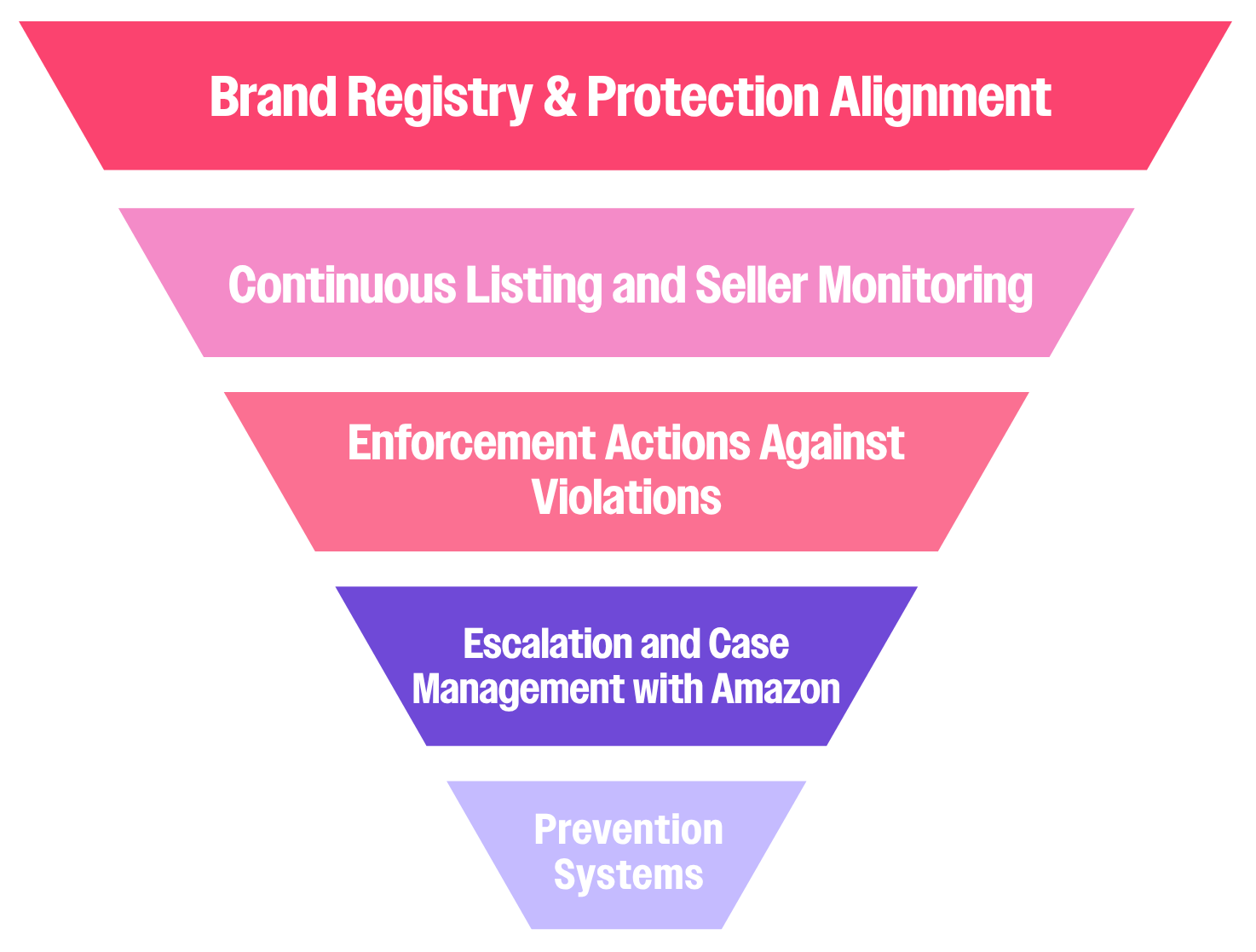
We start by reviewing or completing your Amazon Brand Registry so that enforcement tools can actually be used. This includes verifying enrollment, confirming trademark ownership, and aligning intellectual property details for Amazon to recognize you as the rights owner. Without this foundation, enforcement actions are often limited or rejected because eligibility signals are incomplete or inconsistent.
Our team also audits account and brand structure to ensure your listings, ASINs, and seller permissions are properly tied to the correct brand entity. This removes gaps that hijackers and unauthorized sellers often exploit.
Next, we monitor your ASINs for hijackers, unauthorized sellers, and duplicate or altered listings that attach themselves to your catalog. This includes tracking Buy Box ownership changes to identify when control shifts away from your authorized distribution. We take action when we detect listing edits, new seller injections on branded ASINs, sudden Buy Box loss, or changes in product detail pages that do not match verified brand data.
When violations are identified, we file structured infringement claims directly with Amazon to remove counterfeit or unauthorized listings, including reporting sellers who are misrepresenting products, using your branding without permission, or listing incompatible or fake versions of your ASIN.
Action is triggered using evidence such as trademark registration details, product image comparisons, order testing, listing metadata mismatches, and proof of unauthorized distribution. We use this to support takedown requests and increase acceptance rates.
If claims are rejected or ignored, we manage escalation paths through Amazon support and internal case reviews. This includes re-submitting cases with stronger documentation, correcting rejection reasons, and pushing unresolved issues through higher-level support channels. We also maintain ongoing communication with Amazon to ensure cases are not stalled or closed prematurely, especially in repeat infringement or high-volume hijacker situations.
Beyond enforcement, we implement systems to reduce future exposure. This includes listing control strategies that limit unauthorized edits, brand gating recommendations to restrict seller access, and MAP enforcement guidance to stabilize pricing across channels. The goal is to reduce recurring hijacker activity, prevent duplicate listings, and maintain long-term control over how your brand appears and sells on Amazon.
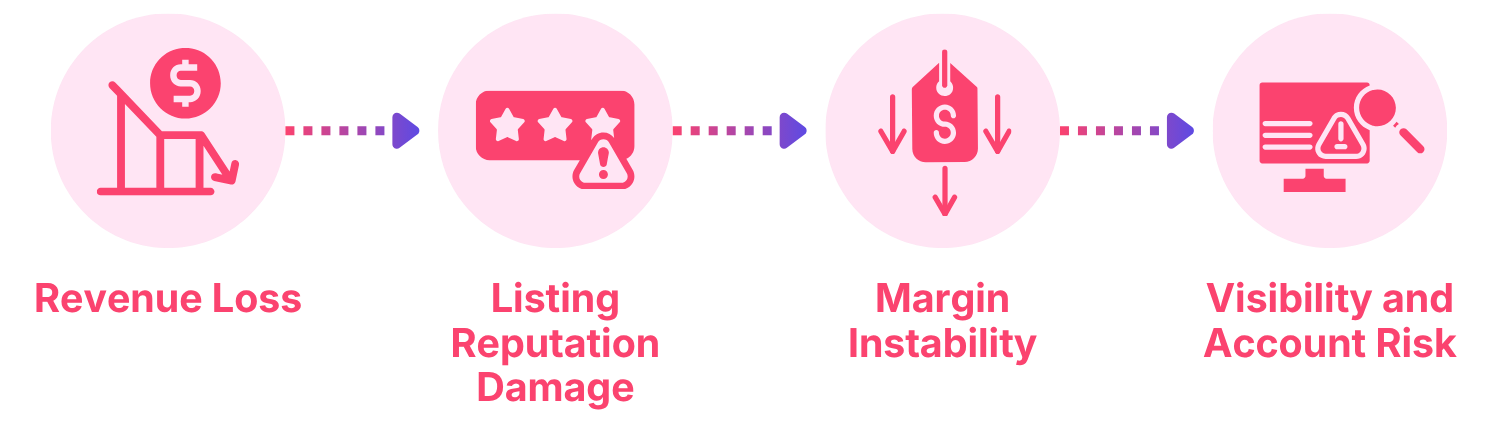
Without proper protection in place, the Buy Box often becomes the first point of failure. When unauthorized sellers take control, sales get redirected away from your listings, creating immediate revenue loss even when traffic stays consistent.
At the same time, the impact shows up in places that are harder to fix. Counterfeit or unauthorized listings tied to your ASIN attract negative reviews from customers who never received your product. Those reviews stay on the listing, lowering conversion rates and eroding trust over time. Pricing pressure follows as well, with unauthorized sellers undercutting your pricing and creating ongoing margin instability.
When the situation escalates, Amazon responds at the listing level. Repeated violations can trigger suppression or account health flags, limiting visibility or removing the product from search results entirely. What starts as small disruptions quickly turns into a full loss of control and sustained performance decline when structured protection is not in place.
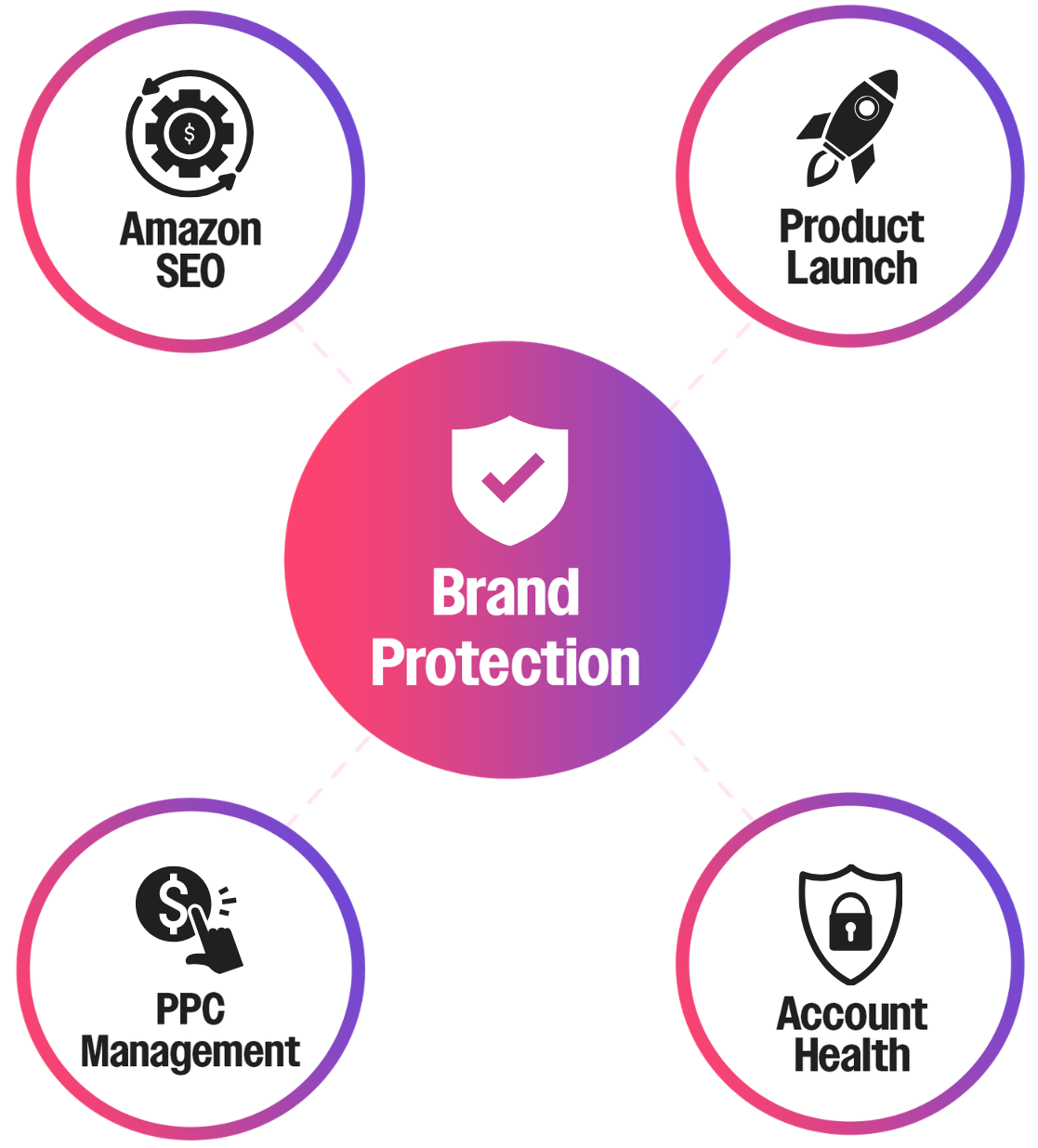
Brand protection is not only about stopping hijackers or counterfeit listings; it directly impacts how well every growth lever on Amazon performs. Amazon PPC Management depends on stable listings and Buy Box ownership. If unauthorized sellers are winning the Buy Box, ad spend gets diluted because traffic is sent to listings you do not fully control. Amazon SEO also relies on clean catalog data and consistent product pages, since duplicated or altered listings weaken ranking signals and reduce organic visibility.
For Amazon Product Launch, brand protection ensures new ASINs are not immediately copied or hijacked, allowing early sales velocity to build without interference. It also supports Amazon Account Health by reducing policy violations tied to counterfeit activity, listing abuse, or customer complaints generated by third-party sellers. In one scenario, a coffee brand we work with experienced listing content removals across 10 of 16 ASINs due to triggering policy terms, which disrupted visibility and stalled performance. After resolving the violations and stabilizing account health, sales recovered from roughly $8.9K to $16.1K, with improved conversion rates and reduced ACOS as ads began pointing to fully compliant, stable listings. Without a protection setup, growth systems are constantly working against unstable listings rather than scaling from a controlled foundation.

Brand Registry is set up, but hijackers, duplicate listings, or unauthorized sellers still attach to your ASINs. These issues continue even with registration in place because setup alone does not remove violations or prevent listing abuse.
Pricing, ads, and demand stay consistent, but Buy Box ownership shifts without warning. Sales are redirected to third-party sellers, leading to immediate revenue loss even when traffic does not change.
Customers report issues with products that did not come from your supply chain. These complaints show up on your ASIN, lowering ratings, reducing conversion rates, and damaging trust with new buyers.
You increase ad spend and maintain steady traffic, but sales fluctuate. Buy Box instability, listing interference, or competing sellers disrupt the purchase path and create unreliable campaign performance.
Most agencies stop at monitoring and sending alerts, whereas our approach is operational and enforcement-driven. Instead of simply notifying brands that an issue exists, we actively manage the resolution process from detection to removal, escalation, and stabilization until control is fully restored.
Brand protection is treated as a revenue-impact function, not just a compliance task. The focus goes beyond removing hijackers to protecting the performance drivers that matter most, including Buy Box ownership, conversion rate stability, pricing consistency, organic ranking strength, advertising efficiency, and overall customer experience.
Rather than operating as a standalone support service, brand protection is built into ongoing account performance management. PPC, SEO, account health, and catalog strategy all depend on stable ASIN infrastructure, so protection work is integrated directly into broader growth operations instead of being handled in isolation.

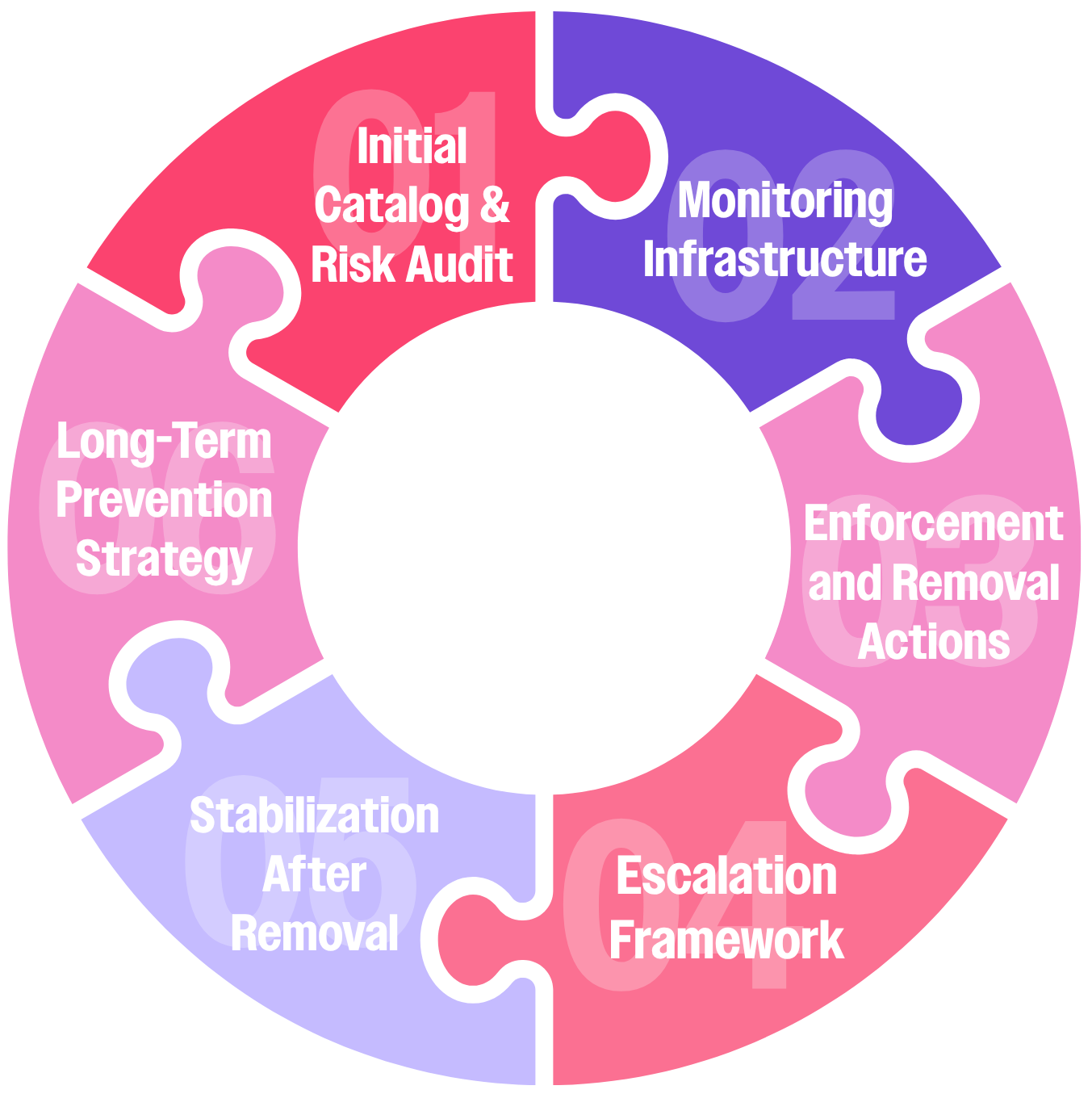
The process starts with a full catalog review to identify both active threats and structural weaknesses across your Amazon listings. This includes reviewing hijackers, unauthorized sellers, counterfeit exposure, duplicate ASINs, merged listings, unauthorized listing edits, pricing inconsistencies, variation abuse, and gaps in Brand Registry setup.
The audit determines where listing control has already been lost, which ASINs require immediate attention, and which issues are actively affecting revenue performance. It also identifies vulnerabilities likely to create future problems so resources can be prioritized toward high-impact ASINs rather than treating every violation with the same level of urgency.
Once the audit is complete, ongoing monitoring systems are established across the catalog to catch issues early before they affect performance. We continuously track Buy Box ownership changes, new seller activity, unauthorized FBA or FBM sellers, listing edits, image swaps, duplicate product pages, pricing disruption, variation changes, and review anomalies.
The goal is early detection, since most revenue loss happens when hijackers remain active for long periods without being caught quickly. Identifying changes early helps reduce PPC waste, ranking volatility, conversion decline, customer confusion, and long-term review damage. Monitoring is prioritized by business impact, with high-revenue ASINs, hero products, and launch-stage listings receiving closer oversight.
Once violations appear, the process shifts from detection into enforcement. Cases are built using evidence such as Brand Registry rights, trademark documentation, authenticity proof, packaging records, GSI validation, listing history, and seller policy violations.
Enforcement actions focus on removing counterfeit sellers, reporting unauthorized resellers, correcting catalog abuse, restoring accurate listing content, reversing improper contributions, resolving duplicate listings, and re-establishing Buy Box control. If Amazon rejects a claim, the case is strengthened and resubmitted until the issue progresses toward resolution.
Some violations require escalation beyond standard support workflows. When claims remain unresolved or Amazon closes cases incorrectly, the issue moves into escalation through higher-tier support channels and additional policy pathways.
This stage includes rebuilding documentation packages, addressing rejection reasons directly, reopening improperly closed cases, consolidating evidence across multiple tickets, and escalating persistent violations until meaningful action occurs.
Resolution rates, escalation success patterns, seller recurrence behavior, enforcement severity by policy category, and average time-to-resolution are continuously tracked to refine how cases are built, positioned, and escalated inside Amazon.
Removing a hijacker is only one part of the process. Once listing control is restored, the focus shifts toward stabilizing performance and preventing ongoing disruption.
This includes monitoring Buy Box consistency, restoring pricing stability, protecting review integrity, preserving SEO indexing signals, preventing duplicate listing recreation, and ensuring catalog consistency across variations. Post-removal monitoring also helps confirm that PPC efficiency, organic rankings, and conversion rates recover properly after enforcement.
The final phase focuses on prevention and infrastructure hardening to reduce the likelihood and severity of future listing attacks. Rather than reacting to violations after they happen, the goal is to create a more controlled catalog environment that limits vulnerabilities before they turn into revenue problems.
This includes strengthening Brand Registry implementation, improving listing authority signals, standardizing catalog structure, reducing contribution vulnerabilities, and proactively flagging high-risk ASINs. Repeat offender sellers are continuously monitored, while launch-stage products receive closer protection because early instability can disrupt ranking, reviews, and sales momentum.
The process also focuses on maintaining cleaner pricing environments and building stronger evidence archives that support faster enforcement if future violations occur. Over time, these systems make listings harder to hijack, improve enforcement speed, help growth campaigns scale more predictably, and minimize long-term revenue disruption.

Once the audit is complete, ongoing monitoring systems are established across the catalog to catch issues early before they affect performance. We continuously track Buy Box ownership changes, new seller activity, unauthorized FBA or FBM sellers, listing edits, image swaps, duplicate product pages, pricing disruption, variation changes, and review anomalies.
The goal is early detection, since most revenue loss happens when hijackers remain active for long periods without being caught quickly. Identifying changes early helps reduce PPC waste, ranking volatility, conversion decline, customer confusion, and long-term review damage. Monitoring is prioritized by business impact, with high-revenue ASINs, hero products, and launch-stage listings receiving closer oversight.
Some violations require escalation beyond standard support workflows. When claims remain unresolved or Amazon closes cases incorrectly, the issue moves into escalation through higher-tier support channels and additional policy pathways.
This stage includes rebuilding documentation packages, addressing rejection reasons directly, reopening improperly closed cases, consolidating evidence across multiple tickets, and escalating persistent violations until meaningful action occurs.
Resolution rates, escalation success patterns, seller recurrence behavior, enforcement severity by policy category, and average time-to-resolution are continuously tracked to refine how cases are built, positioned, and escalated inside Amazon.
The final phase focuses on prevention and infrastructure hardening to reduce the likelihood and severity of future listing attacks. Rather than reacting to violations after they happen, the goal is to create a more controlled catalog environment that limits vulnerabilities before they turn into revenue problems.
This includes strengthening Brand Registry implementation, improving listing authority signals, standardizing catalog structure, reducing contribution vulnerabilities, and proactively flagging high-risk ASINs. Repeat offender sellers are continuously monitored, while launch-stage products receive closer protection because early instability can disrupt ranking, reviews, and sales momentum.
The process also focuses on maintaining cleaner pricing environments and building stronger evidence archives that support faster enforcement if future violations occur. Over time, these systems make listings harder to hijack, improve enforcement speed, help growth campaigns scale more predictably, and minimize long-term revenue disruption.
It is the process of protecting your listings, brand identity, and sales on Amazon from hijackers, counterfeit products, and unauthorized sellers.
It identifies and removes violations that impact your listings, including counterfeit products, duplicate listings, and unauthorized Buy Box ownership, while restoring control of your ASINs.
Yes. Brand Registry provides the enforcement tools needed to report violations, remove infringing listings, and protect your catalog more effectively.
Removal happens through enforcement claims backed by brand ownership, product evidence, and listing data that proves unauthorized use or misrepresentation.
Counterfeit listings can be reported and removed through Amazon enforcement, but they often require strong evidence and follow-up to fully eliminate and prevent repeat issues.
Timing varies depending on the case, but simple removals can happen quickly while escalations may take longer if Amazon requires additional review.
Yes, especially for brands with established sales. Without it, hijackers, pricing disruption, and counterfeit activity directly reduce revenue and damage long-term listing performance.
Stop losing sales to hijackers, counterfeit listings, and unauthorized sellers that disrupt Buy Box ownership and damage conversions. Strengthen your brand protection to keep control of your catalog, protect pricing stability, and maintain consistent revenue performance.
Book Your Call