Running Google Ads should produce measurable revenue, not unanswered questions about where your budget is going. Many ecommerce brands reach a point where ad spend continues to increase while performance remains flat. Campaigns generate clicks, budgets get consumed, and reports show activity but revenue growth doesn't always follow.
A common problem is that campaigns are left running without enough ongoing optimization. Search terms drift away from buyer intent. Product feeds become outdated. Budgets remain allocated to underperforming campaigns. Creative assets fatigue over time. As a result, brands waste spend on traffic that isn't converting while missing opportunities to capture higher-intent shoppers.
Our management service is designed for ecommerce businesses that want more than campaign setup. We provide hands-on management focused on improving profitability, increasing visibility into performance, and identifying where your advertising budget is creating measurable business impact.
Successful performance across Google Search Ads, Google Shopping Ads, Display campaigns, and YouTube advertising depends on continuous testing and refinement. We monitor campaign data, evaluate audience behavior, analyze product-level performance, and make ongoing adjustments designed to improve efficiency and scale what works.
Instead of relying on assumptions, we use performance data to guide decisions around bidding strategies, targeting, product feeds, creative assets, budget allocation, and campaign structure. This helps ecommerce brands move beyond simply generating traffic and toward building a paid acquisition system that supports sustainable growth.
This service is designed for ecommerce brands that are already running Google Ads and want a more structured approach to improving performance. Rather than starting from scratch, the focus is on turning existing ad spend into more consistent and predictable growth.
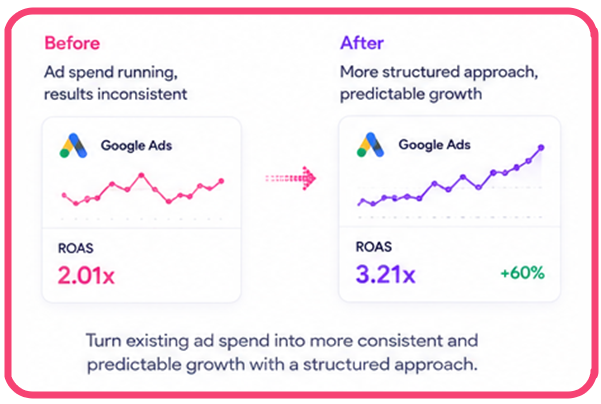

As budgets increase, small inefficiencies in targeting, bidding, and campaign structure can become expensive. We help growing brands maintain efficiency as they scale and avoid the performance instability that often comes with higher spend.
If performance fluctuates from week to week without a clear explanation, it often points to gaps in optimization, testing, or campaign diversification. We help create a more stable and data-driven acquisition strategy.

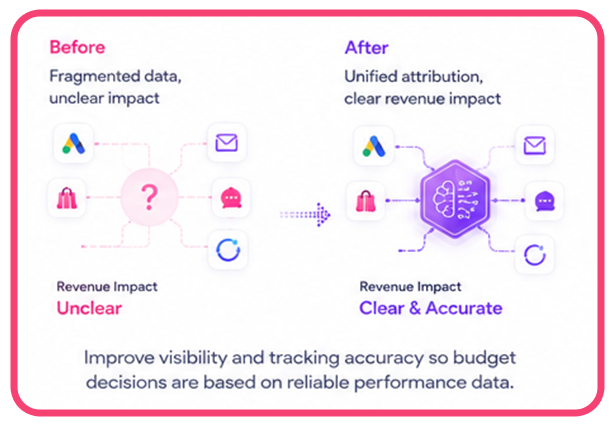
When reporting is fragmented or tracking is inaccurate, it becomes difficult to understand what is actually driving revenue. Our service helps improve visibility so that budget decisions are based on reliable performance data.
High traffic doesn't always translate into profitable growth. Therefore, we help identify issues related to keyword targeting, product feed optimization, campaign structure, and conversion efficiency that may be limiting returns.
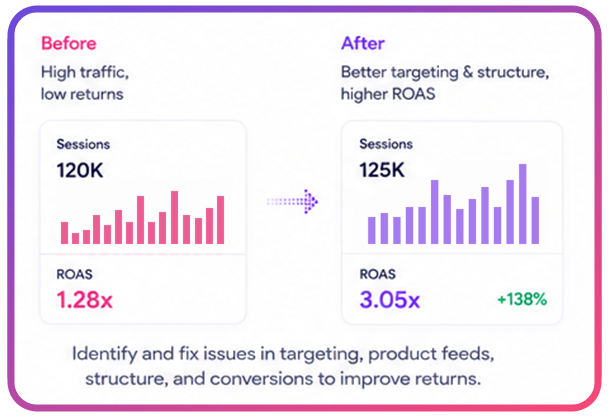
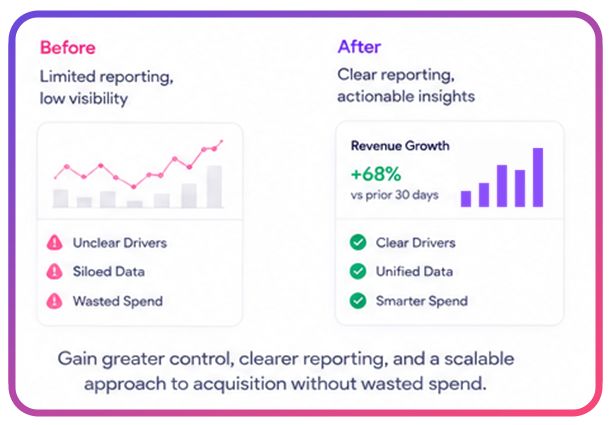
This service is ideal for ecommerce brands that want greater control over performance, clearer reporting, and a more scalable approach to customer acquisition without increasing wasted spend.
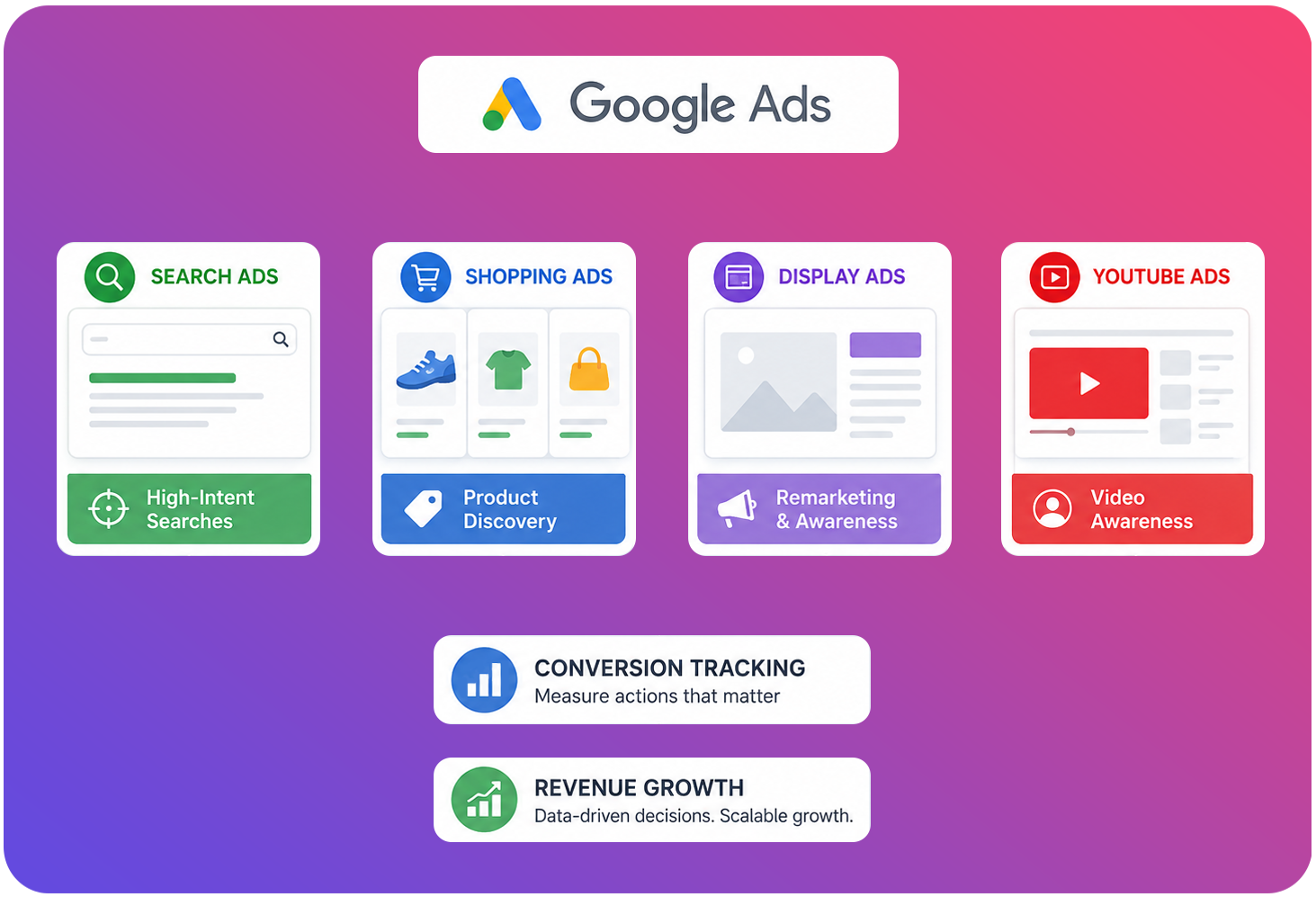
We manage Google Ads as an integrated system, not isolated campaigns. Most performance issues happen when Search, Shopping, Display, and YouTube are treated separately instead of working together across the full funnel.
Our management services are built to align all four channels with a single goal: improve profitable acquisition and scale what is already working. Each part of the account has a specific role, and we actively manage each layer through testing, optimization, and ongoing performance review.
Search campaigns are where ecommerce brands frequently capture their highest-intent customers, but they're also one of the most common sources of wasted spend. Many accounts accumulate thousands of dollars in spend from irrelevant search terms, broad keywords that attract low-intent traffic, or bidding strategies that prioritize volume over profitability.
Our team focuses on understanding how users are actually searching and buying. We regularly analyze search term data to identify which queries generate revenue and which consume budget without producing meaningful results. This allows us to refine keyword targeting, expand high-performing opportunities, and exclude searches that don't align with purchase intent.
Optimization decisions are driven by performance data rather than fixed rules. If certain keywords generate strong conversion rates, we may increase visibility through bidding adjustments or budget reallocation. If traffic is converting poorly despite strong click volume, we investigate factors such as keyword intent, ad messaging, and landing page alignment to identify where friction exists in the customer journey.
We also continuously test ad copy and evaluate how different messaging influences both click quality and conversion behavior. The goal isn't simply to generate more traffic, but to consistently capture demand from users most likely to purchase while reducing spend on low-value searches.
Google Shopping campaigns are often the largest revenue driver for ecommerce brands; however, they are also highly sensitive to feed quality and product-level optimization. Many performance issues originate in the feed itself rather than the campaign settings.
Common problems include incomplete product titles, missing attributes, weak category mapping, disapproved products, or large portions of the catalog receiving spend despite generating little revenue. It's also common to find high-performing products grouped together with low-performing SKUs, which makes budget allocation and optimization less effective.
Our management focuses on identifying and correcting these issues before they suppress visibility, clicks, or ROAS. This includes refining feed data, segmenting products by profitability and sales performance, maintaining Merchant Center health, and analyzing results at both the product and category level.
Product-level analysis is critical because a small percentage of SKUs often generates most of the revenue while other products consume budget with minimal return. Identifying those patterns enables more effective bidding, budgeting, and optimization decisions across the catalog.
Display and remarketing campaigns are designed to recover lost traffic and maintain visibility throughout the buying journey, but they can underperform when audiences are too broad, attribution is unclear, or campaign decisions are based on incomplete data.
Many ecommerce brands face tracking challenges that make remarketing performance difficult to evaluate. Conversion events may be missing, platform-reported ROAS may not align with actual sales data, or multiple channels may claim credit for the same conversion. Without validating tracking and attribution first, it becomes difficult to determine whether a campaign is genuinely driving revenue or simply receiving credit for conversions that would have happened anyway.
Performance improvements begin with understanding how users interact with your site and where they exit the funnel. We segment audiences based on behavior and engagement depth, allowing us to deliver more relevant messaging to users who have viewed products, added items to cart, or shown other high-intent signals. We also test display creatives and retargeting strategies to identify which combinations contribute most effectively to conversion recovery.
By combining audience segmentation, funnel-specific messaging, and validated performance data, Display and remarketing campaigns become more than awareness tools. They serve as a measurable part of the acquisition strategy, helping recover potential revenue and support conversions that might otherwise be lost.
YouTube helps ecommerce brands expand reach and reinforce messaging across mid and upper-funnel audiences, especially for products with longer consideration cycles. However, performance suffers when campaigns are structured too broadly or managed separately from the rest of the acquisition strategy.
A common issue is grouping multiple objectives, audiences, and products into the same campaign. This makes it difficult to identify what is driving engagement, where budget should be allocated, and which audiences are contributing to conversions.
Our approach organizes campaigns by audience intent, funnel stage, and product focus. Awareness, remarketing, and product-specific campaigns are separated to create clearer reporting, better optimization opportunities, and more informed budget decisions. We use behavioral and intent signals to build targeted audiences, connect YouTube with Search and Shopping campaigns, and create mid-funnel engagement campaigns that keep potential customers moving toward purchase.
Rather than operating as a standalone channel, YouTube supports acquisition, remarketing, and audience development across the broader Google Ads strategy.
Google Ads accounts do not underperform because of setup alone. They underperform because nothing is actively managed after launch. Our Google Ads service is built around continuous optimization, where decisions are made weekly based on search behavior, product performance, and conversion data.
This is where most ecommerce brands see the difference. Instead of letting campaigns run on autopilot, we actively adjust structure, targeting, budgets, and creative based on what is actually driving revenue, not just clicks or impressions. For example, if a campaign is generating strong traffic but low sales, we investigate search intent, landing page alignment, and audience quality before allocating additional budget. Likewise, if a product category is consistently outperforming others, we may shift spend toward that segment to capture more profitable demand.
We focus heavily on eliminating wasted spend, improving signal quality inside the account, and scaling only what consistently converts. In practice, this often means identifying search terms that generate clicks without purchases, excluding low-value traffic through negative keywords, reallocating budget from underperforming campaigns to stronger performers, or restructuring campaigns when reporting lacks enough visibility to support optimization decisions.
Rather than relying on assumptions or automated recommendations alone, optimization decisions are based on actual performance patterns within the account. The goal is to continuously improve efficiency while creating a stronger foundation for sustainable growth.
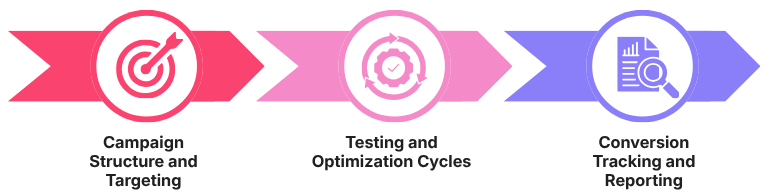
Campaign structure is one of the most important factors in long-term performance. Poor structure leads to diluted data, weak optimization signals, and inefficient budget distribution. Our process builds accounts around intent, not just products or keywords.
This includes:
This structure allows us to clearly identify where performance is coming from and adjust budgets based on actual conversion behavior, not surface-level engagement.
Optimization isn't a one-time activity. It's a continuous cycle that directly impacts efficiency and scalability across your ads.
Our process involves:
We don't rely on static campaign settings. Instead, we treat every account as a testing environment where small improvements compound into meaningful performance gains over time.
Without accurate tracking, even well-optimized campaigns can be misleading. A large part of our management process is ensuring that performance data reflects actual revenue impact.
We focus on:
This level of tracking allows us to make confident scaling decisions. Instead of guessing where to increase the budget, we identify specific campaigns, products, and audiences that consistently generate profitable returns and scale them with intent.
Most ecommerce brands reach a point where ad spend is increasing, but clarity is decreasing. Campaigns show activity, reports show clicks and impressions, yet it's still unclear which parts of the account are actually driving profitable revenue.
When budgets are split across Google Search Ads, Google Shopping Ads, Display, and YouTube, small inefficiencies start to compound. Without proper structure and ongoing optimization, it becomes difficult to separate high-performing campaigns from wasted spend.
We help brands cut through that uncertainty with a focused management team that evaluates what is working, what is underperforming, and where performance can be improved.
A strategy review focuses on:
This isn't a surface-level audit; it's a practical breakdown of how your account is currently performing and what changes would directly impact profitability and scale. If you are spending heavily on paid search but still unsure what is actually driving revenue, this is the point where a structured approach to optimization becomes more important than additional budget.
Request a Google Ads Audit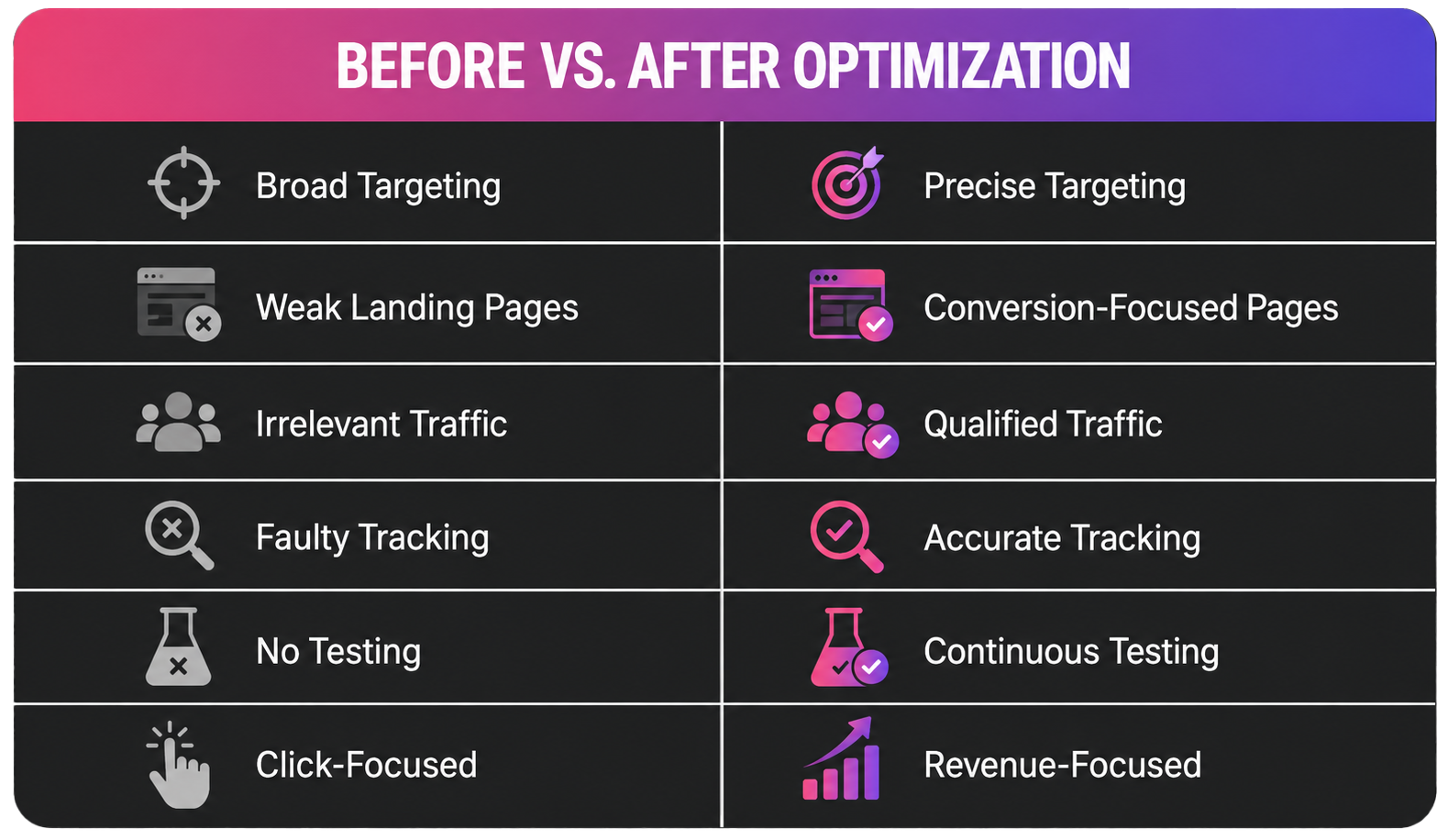
Campaigns often target audiences that are too broad, resulting in lower conversion rates and wasted spend. For example, showing non-brand Shopping ads to generic high-volume searches can drive clicks from users with no purchase intent.
Even well-targeted traffic struggles to convert when landing pages fail to match user expectations or provide a clear purchase path. A mismatch between ad messaging and product page details often leads to high bounce rates and abandoned carts.
Without proper keyword control, campaigns can generate large volumes of irrelevant traffic. For instance, bidding on broad terms without exclusions can pull in research-based queries that rarely convert into sales.
Campaigns that remain unchanged for months can stagnate. Performance improvement requires consistent testing and iteration. Without structured A/B testing for ads or audiences, it becomes difficult to identify what actually drives incremental lift.
Faulty tracking creates misleading data, making optimization decisions less effective. If purchase events are missing or duplicated, the algorithm may over-invest in underperforming campaigns.
Increasing budgets without understanding campaign limitations can reduce efficiency and increase acquisition costs. Rapid budget increases amplify existing inefficiencies rather than improving performance.
Traffic alone doesn't indicate success. Sustainable growth requires focusing on revenue, profitability, and customer acquisition efficiency. High CTR campaigns can still lose money if they attract low-value or non-buying traffic.
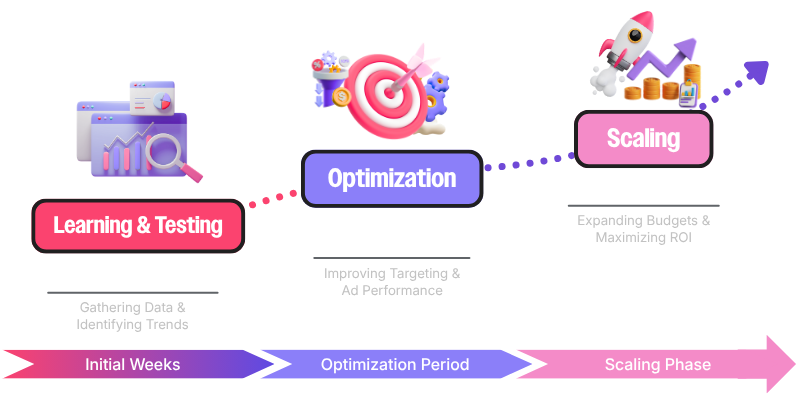
Success with Google Ads doesn't happen immediately after launch, and it rarely follows a straight upward curve. For most ecommerce brands, performance moves through clear phases driven by data accumulation, testing, and optimization.
Our service is designed to guide campaigns through these stages in a controlled way, so scaling decisions are based on consistent signals, not early fluctuations.
Google Ads works best as part of a broader ecommerce acquisition strategy, not in isolation. It captures high-intent demand at the bottom of the funnel, while other channels support awareness, consideration, and re-engagement. Our service is designed to improve overall marketing efficiency by aligning Google Ads with your wider channel mix.
Meta Ads and TikTok typically drive awareness and early-stage demand, while Google captures users actively searching to buy. For marketplace brands, Walmart growth adds another layer of product demand that Google can reinforce through Search and Shopping.
Google Ads also supports organic SEO by revealing high-converting keywords and product opportunities, while SEO reduces long-term reliance on paid traffic. Retargeting through Display and YouTube helps re-engage users from Meta, TikTok, and organic traffic who didn't convert.
When channels operate separately, data is fragmented and spend overlaps. When aligned, each platform strengthens the others and improves overall acquisition efficiency.
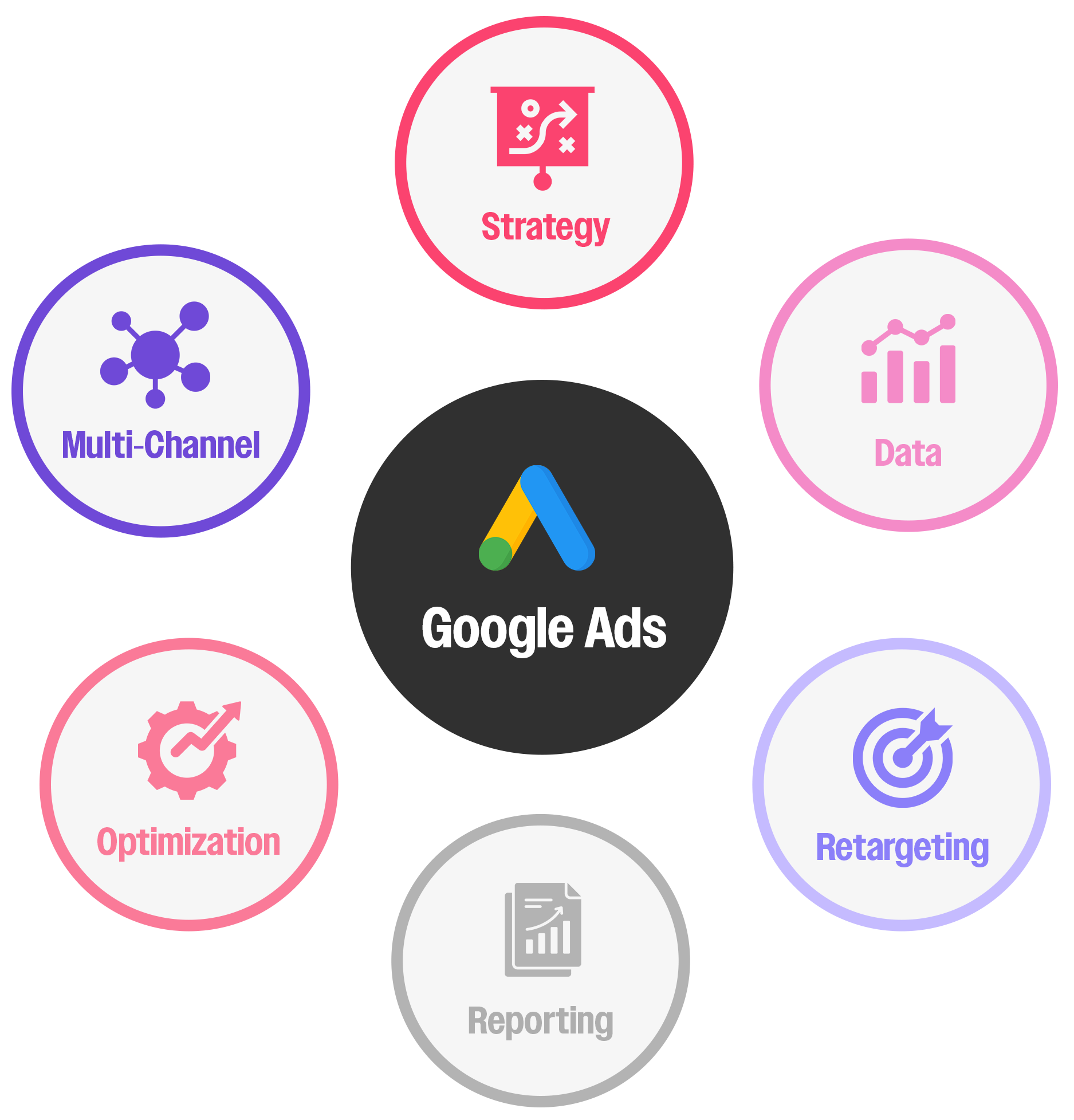
Whether you need better ROAS, cleaner targeting, or a scalable acquisition strategy, our team manages the day-to-day optimization behind your campaigns while helping you make more informed growth decisions. The focus is on improving efficiency, reducing wasted spend, and scaling what is already working across Search, Shopping, Display, and YouTube.
If your current account feels like it has plateaued or you are unsure where your budget is actually driving revenue, the next step is a structured review of your campaigns and performance data.
Speak With Our Team